
Four Week Breathwork Challenge
Rhythms of Renewal - Tahoe Forest Group
Week 1 - Grounding, Awarenesss and Letting go
Welcome to the 4-Week Breathwork & Somatics Challenge.
I invite you to join me for a 4-week journey into the power of breathwork and simple somatic practices. Each week, we’ll explore a different set of techniques to help you regulate stress, build resilience, and reconnect with your body.
This course is designed to give you a broad, solid foundation and the practical skills to use your breath as a tool for health, growth, and meaningful change - physically, mentally, and emotionally.
Your minimum practice formula: 10 + 10 + 10 × 2
10 minutes in the morning
10 minutes at night
10 mini-resets during the day (1–2 minutes each)
The goal isn’t to do everything perfectly—it’s to build a steady rhythm you can return to whenever life feels intense.
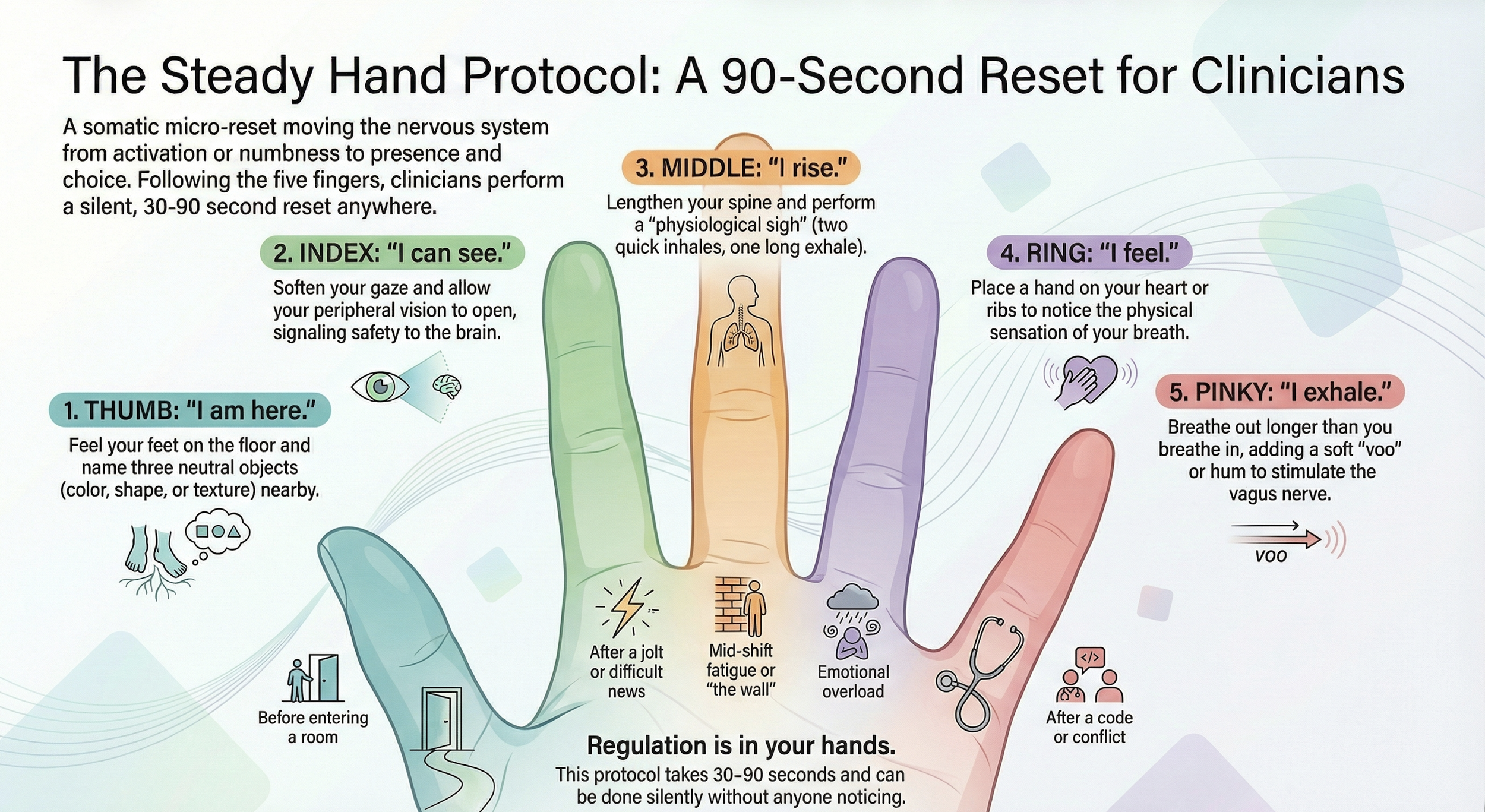
-
Why it works: This practice provides your nervoussystem with immediate, tangible proof of safety through sight and touch, interrupting the brain's threat cascade.Tagline: Let the environment hold a little of you.
Why it works: This practice provides your nervous system with immediate, tangible proof of safety through sight and touch, interrupting the brain's threat cascade.
Track it (signs it's working): Jaw softens, exhale lengthens, shoulders drop, thoughts slow, peripheral vision widens, swallow/sigh/yawn appear, eyes feel softer.
Teach-a-Patient Script (15 sec):
"I want to help your body feel a little steadier. Look around this room and pick three things you can see—maybe a color, a shape, something your eyes can land on. Good. Now feel your feet on the floor or your body in the chair. Take one slow breath in through your nose, and as you breathe out, let it be longer than the inhale. That's it. Notice anything different?"
Breathing Exercises on You Tube:
Protocol 4: Shake + Tap + Unclench (45-60 seconds)
When: After a code, after an emotionally intense room, whenever you feel tremor or"unfinished adrenaline" in your body, end of shift, when your jaw is locked or shoulders are up to your ears.
How:
Shake hands gently
Let tremor travel up arms, shoulders. Nothing dramatic.
Tap gently:
Collarbone, chest, arms, face (like you're lightly tapping someone awake).
Unclench jaw:
Let it hang slightly. Soften tongue. Release tension behind the eyes.
Optional tap feet
— Roll ankles, press heels into ground.
Tagline: Like shaking sand out of a towel—gentle, effective
-
Why it works:
Tremoring and tapping activate your parasympathetic nervous system(rest/restore). It's a direct signal:
the threat is past, the body can relax now.
This is literallyhow animals discharge after escape.
Track it (signs it's working):
Tremor or internal vibration releases
Jaw softens, tongue relaxes
Exhale deepens
Heat in the body disperses
Shoulders drop
Dial down / Do not use if:
Shaking feels activating instead of releasing → make movements smaller, slower,more contained
You feel exposed shaking in public → do it in a bathroom stall or car (30 sec isenough)
You have tremor-sensitive trauma → try very gentle tapping instead of shaking
Teach-a-patient script (20 sec):
"Sometimes after something intense, our bodies need to move a little to release tension. Letme show you: shake your hands gently, let your shoulders roll, unclench your jaw. Feel that?That's your body finishing what it started. It's healthy
Protocol 6: VooRaar + Claw Reset (Vagal tone + defensive completion)
When:
After shock, frustration, or emotional charge • When frozen but activated • Jaw/throat/diaphragm tight • After holding back words • Before sleep with agitation
How — Option 1: VooRaar Only
Inhale gently through nose.
Exhale with a long, low “VooooRaar” (Voo turning into a growl).
Feel vibration in chest/throat/belly.
3–6 repetitions
ARRIVAL PRACTICE (90 seconds)
Step 1: Notice early warning signs (30 sec)
Without judgment, ask yourself:
Is my jaw clenched?
Are my shoulders up?
Am I rushing?
Have I lost touch with why I do this?
Do I feel invisible or unheard?
Is compassion feeling thin?
Just notice. Don't fix yet.
Step 2: Feel your feet + your back (30 sec)
Ground into the support beneath you. Feel where you're held.
Step 3: Unclench + One long exhale (30 sec)
Jaw soft, tongue soft, eyes soft. One slow exhale. Notice the shift even slightly.
When: Before/during high-stakes conversation, before procedure, when you're bracing forconflict, when you need crystalline clarity under pressure, when anxiety is rising.
How: Box Breathing (for people who like structure):
Inhale for 4.
Hold for 4.
Exhale for 4.
Hold for 4.
Repeat 4–5 cycles.
Gentler 3-2-5 (for people who get activated by holds):
Inhale for 3.
Pause for 2 (not a hard hold—just a natural pause).
Exhale for 5.
Repeat 4–5 cycles.
Tagline: Choose your dose. Structure isn't one-size-fits-all.
-
Why it works:
Both practices use rhythm and predictability to settle anxiety. Box breathingis symmetrical and precise. The 3-2-5 version is gentler, with a longer exhale for people whoget dysregulated by breath holds.
Track it (signs it's working):
Clarity returns
Anxiety drops a notch
You can feel your feet again
Thoughts slow down
You can access your next choice
Dial down / Do not use if:
You feel panicky with the structure → just do natural breathing with a longer exhale
You feel lightheaded → switch to the gentler 3-2-5 version
Counting activates you → skip it, just focus on smooth breathing
Teach-a-patient script (20 sec):
"Let's breathe together in a pattern that helps your nervous system settle. Breathe in for 3,pause for 2, breathe out for 5. Again. Notice how that feels. Your nervous system is learning:I can be steady even when things are hard."
ARRIVAL PRACTICE (Do this now, 90 seconds)
Step 1: Notice your sleep state (20 sec)
On a scale of 0–10, how wound up is your nervous system right now?
Are you tired or just numb?
Can you feel your body or is it far away?
Step 2: Feel your weight (30 sec)
Lie down or sit comfortably.
Feel the support beneath you—how the chair or bed is holding your full weight.
Imagine your body getting heavier, more settled.
Step 3: Gentle breath + body scan (40 sec)
4-in / 6-out for 4 breaths.
Notice any areas that still feel held or tight.
Notice any areas that feel soft.
PROTOCOL 14: Yoga Nidra–Style Body Scan (Sleep Integration)
When: Bedtime (main use), before naps, when you have 10–20 minutes and want deepnervous system reset, for integration after emotional intensity.
How: Lie down on your back (or reclined if that's more comfortable).
Let your eyes close.
Breathe naturally.
Guided scan (15 min; or you can shorten):
Forehead and eyes:
Feel the cool air on your forehead. Notice if there's any tension behindyour eyes. You don't have to change it. Just notice and breathe.
Jaw and throat:
Feel your jaw. Let it rest. Feel your tongue—let it be wide and soft. Feel yourthroat opening.
Chest and heart:
Feel your heart space. Feel it rise and fall with your breath. No effortneeded.
Belly:
Feel your belly softening. Feel gravity pulling your belly down.
Low back and hips:
Feel where your back touches the surface beneath you. Feel that support.Feel your hips settling.
Legs and feet:
Feel your thighs heavy. Feel your calves. Feel your feet. Feel the ground (orbed) holding all of you.
Whole body:
Feel yourself held. Feel the support beneath you. Feel yourself getting heavier,more settled.
Tagline: You're not fixing the body. You're meeting it.
-
Why it works:
Body scans train your nervous system to feel your body (vs. dissociate), andto trust the support beneath you. This is profound sleep-work.
Track it (signs it's working):
You fall asleep during or right after
You wake feeling more integrated (less scattered)
You remember your dreams (good sign of deeper sleep)
You feel less tense the next morning
Dial down / Do not use if:
You have dissociation or trauma → use a shorter version (5 min) and includeorienting (name 3 things you see) before the scan
You feel anxious lying down → do a seated version instead, or do the scan sitting up
You're too activated to rest → do Protocol 7 (5-minute discharge) before the bodyscan
Teach-a-patient script (20 sec):
"We're going to do a body check-in that helps your nervous system settle. Just lie back and
PROTOCOL 14: Yoga Nidra–Style Body Scan (Sleep Integration)
let me guide you through noticing different parts of your body. You're not trying to changeanything—just noticing. This helps your system know it's safe."
Protocol 1: Orient + Contact
When: In a doorway, in the hallway, before entering a patient's room, after a jolt or "beeper surge," anytime you feel spun up or floaty.
How: Eyes open: Name 3 neutral objects you can see (a color, a shape, a patch of light).
Standing: Feel both feet on the floor and one point of contact (your hand on a doorframe, your badge, or your own arm).
Seated: Feel your feet on the floor, your seat in the chair, and your back being supported.
One long exhale: Breathe in normally, then let the exhale be long and slow, as if you're pouring water from a cup.
Tagline: Let the environment hold a little of you.
Protocol 2: Orient + Contact
When: During an acute stress spike, after an adrenaline surge, before a difficult conversation, when your heart rate jumps.
How: Take two quick sniffs in through the nose—like you're topping off the lungs, then topping off again.
Let out one long, slow exhale through the mouth or nose, like fogging a mirror.
Repeat 2–3 rounds.
Tagline: A brake pedal in your pocket.
-
Why it works: The physiological sigh is a neurobiologically designed reflex that resets lung stretch receptors, sending a powerful safety signal to your nervous system. It is one of the fastest known ways to downregulate during an adrenaline spike.
Track it (signs it's working): Heart rate drops noticeably, you can feel your exhale lengthening, shoulders drop, thinking clears, you can access choice again, a natural swallow/sigh/yawn may appear.
Teach-a-Patient Script (20 sec):
"Let's try a quick breathing reset. Two quick sniffs in through your nose—like you're topping off—then one long slow exhale like you're fogging a mirror. Again. Notice your shoulders dropping a little. One more time. How's that?"
Week 2 - Discharge — Release Without Dumping
Protocol 5: Humming Exhale + Voo (Vagal toning with sound)
When: End of shift, tension residue, after hard room, before sleep, anytime you needdownshift without intense breath work, for nervous system regulation.
How: Hum version:
Inhale through the nose.
Exhale with a soft hum "mmmm"—feel vibration in lips, face, throat, chest.
3–5 rounds.
Voo version:
Inhale gently through the nose.
Exhale with a long "vooooo"—like a foghorn, steady and comfortable.
3–5 rounds.
Tagline: Vibration tells the nervous system: you are not in danger now.
-
Why it works:
Sound and vibration directly stimulate the vagus nerve, your "rest andrestore" pathway. This is why lullabies work, why chanting works, why humming feelssoothing. It's not spiritual—it's neurobiological.
Silent version (if you need to be discreet):
Mouth closed, barely audible hum. You'll still feel the internal vibration.
Track it (signs it's working):
Face and jaw relax
Exhale feels longer and smoother
A sense of settling in the chest/throat
Calm without effort
Dial down / Do not use if:
You feel self-conscious about sound → do the silent version, or do it alone in your car
Sound activates trauma responses → skip this one, use another protocol
You have vocal strain → keep it gentle, quiet, short
PROTOCOL 5: Humming Exhale + Voo (Vagal Toning with Sound)
Teach-a-patient script (20 sec):
"Want to try something that helps the nervous system settle? Breathe in through your nose,then on the exhale make a long 'vooooo' sound like a foghorn, until your lungs feel empty.Again. Feel how that lands? That's your body saying it's safe to come down."
How — Option 2: VooRaar + Claw
Hands in front, fingers softly curved.
Inhale.
Exhale with “VooooRaar” while slowly extending arms forward in a clawing/pushing motion.
Return arms slowly. Pause. Notice.
Repeat 3–5 times.
Finish with one quiet breath.
Tagline: Sound moves charge. Motion completes freeze.
-
Why it works:
• Vocal vibration stimulates the vagus nerve
• Long exhale reduces sympathetic activation
• Clawing completes suppressed fight response
• Discharges energy without rehashing the storyBottom-up regulation. Not catharsis — completion.
Track it (signs of shift):
Spontaneous sigh/swallow • Jaw softens • Warmth/tingling in hands • Breath deepens • Subtle tremor • Wider vision • Sense of strengthDial Down / Avoid If:
Dissociating → orient first (name 3 objects)
Sound feels vulnerable → silent pursed-lip exhale
Anger escalates → reduce intensity, slow movement
Throat sensitivity → hum insteadTeach-a-Patient (20 sec):
“Take a gentle inhale. As you breathe out, make a long low ‘Voooo.’ If it feels right, slowly push your hands forward like you're moving something away. Again. That sound and motion tell your nervous system it doesn’t have to hold that charge.”
Week 3 - Boundaries
Protocol 7: Embodied Boundary Setting (Wall Push + Visualization)
When: Before saying yes to something that doesn't fit, when you feel your boundary beingcrossed, when you need to feel resourced in your body, anytime you're losing your "no."
How:
Physical version (60 sec): Stand facing a wall.
Place both palms on the wall at shoulder height.
Press slowly—feel your strength, your solidity, your capacity.
Keep your breath steady.
Hold for 10–15 seconds, then release and notice sensations.
Repeat 2–3 times.
Visualization (optional, add 30 sec):
Now visualize a boundary line around you—not a fortress, just a clear, kind perimeter. Likea fence with a gate. You control who comes in and who stays out.
Feel that in your body.
Tagline: A fence with a gate—not a wall, not a trap door.
-
Why it works:
This practice gives your nervous system kinesthetic proof:
I have strength. Ican say no. I can hold a boundary.
It's not aggressive. It's resourced.
Track it (signs it's working):
You feel solid, grounded
Shoulders are back and down
You can feel the word "no" in your body without guilt
Jaw/throat soften
You feel yourself more clearly
Dial down / Do not use if:
Wall push feels activating instead of grounding → just visualize the boundary, skipthe push
You're in a public space → visualize it internally
You feel weak or depleted → pair this with orienting first (three objects you see)
Teach-a-patient script (20 sec):
"Your body has the right to a boundary. Put your hand on your heart and feel that youmatter. Imagine a clear, kind line around you—you decide who comes in, who stays out.You're not being selfish. You're being protective of something precious."
Common mistake + fix:
Mistake:
"I pushed on the wall but I still can't say no to things."
Fix:
Boundaries are practiced through repetition. Do the wall push once a day for aweek, then practice saying no once that week. The body learns through both thepractice AND the real-world application. You're building a reflex.
PROTOCOL 8: Embodied Boundary Setting (Wall Push + Visualization
Week 4 - Replenish and Teach Forward
PROTOCOL 13: 4-7-8 Breathing (Optional; Comfort-First)
When: Bedtime, chronic insomnia, when you need a stronger downshift than 4/6, optionalfor people who like structured breath holds (not mandatory).
How:
Inhale through the nose for 4.
Hold for 7 (this is the active ingredient—the CO₂ rise signals calm).
Exhale through the mouth for 8 (long, slow, complete).
Repeat 4 cycles.
Tagline: A prescription-strength downshift. Not for everyone. For people who need it.
-
Why it works:
The longer exhale + the hold = maximum activation of the parasympatheticnervous system. This is stronger than 4/6. It should feel noticeably calming.
Alternative if holds feel uncomfortable:
Stick with 4/6, or try 3/5 (in for 3, out for 5), whichgives the same exhale-emphasis without a hold.
Track it (signs it's working):
Drowsiness within 5 minutes
Jaw releases significantly
Exhale feels like a sigh
Heaviness in limbs
Thinking quiets
Dial down / Do not use if:
You feel panicky with the hold → switch to 4/6 (no hold)
You have cardiac issues → consult your doctor; gentle 4/6 is safer
You're pregnant → gentle breathing only; avoid holds
It activates instead of calms → this isn't your practice; use 4/6 instead
Do not teach to patients:
This hold-based practice requires screening. Use the gentlerprotocols for bedside teaching.
Protocol 3:
4-in/6-out Nasal Breathing (Paced Breathing for Longer Cycles).
When: Throughout your shift as a steady rhythm, before sleep, when you need sustainedcalm over a longer period (5–10 minutes), as a meditation-lite option.
How:
Breathe in through the nose for a count of 4.
Breathe out through the nose for a count of 6.
Repeat for 4–6 cycles (or until you feel settled).
Tagline: A steady rhythm that tells the nervous system: we're safe now
-
Why it works: A longer exhale activates the vagus nerve, which is the "rest and restore"pathway of your nervous system. Nasal breathing (vs. mouth breathing) has additional calming effects….
Timing options:
30 sec:
3 cycles of 4/6
60 sec:
6 cycles of 4/6
2 min:
12 cycles of 4/6
Track it (signs it's working):
Exhale feels noticeably longer and smoother
Body feels heavier (good heavy, like settling)
Mind gets quieter
You can feel a subtle sigh or swallow
Dial down / Do not use if:
Counting feels annoying → just focus on making exhale longer than inhale, skip thenumbers
You feel trapped by the structure → return to natural breathing, then try again
You have nasal congestion → use mouth breathing, or wait until nasal passages clear
Teach-a-patient script (20 sec):
Teach-a-patient script (20 sec):
"Try breathing in through your nose for a slow count of 4, then out through your nose for aslow count of 6. In 4… out 6… In 4… out 6… Feel how your shoulders release as you exhale.That's your body coming home.".
Week 2 -